It’s Championship Sunday in the National Football League, and it’s snowing heavily at home in New Jersey. Small wonder that I got the urge to pull out one of the tabletop games I played in my high school days during winters in snowy Cleveland — NFL Strategy. Introduced in 1970 by Tudor, the company that made the vibrating “electric football” games popular in the 1950s and 1960s, NFL Strategy was a “board game” only in a general sense.
Plays were made on a plastic case about the size of the TRS-80 portable computers that Radio Shack would produce in the 1980s. The main part of the case was a football field. On it was a slider football with settings for plays from the center, left and right sides of the field. Plastic controls above recorded the score, time to play and timeouts remaining.
Designed for two players, the game had offensive and defensive play cards — runs, passes and specialty plays like the flea flicker. For each player, whoever was on offense would select a play card and put it into the play window on the right side of the case. The player on defense would pick a formation from a separate stack of cards and place the choice in the slot over the offense’s card.
Windows on the defense card would show potential results from the offense card. Results were determined by pulling back a “probability bead” on a spring and letting it bounce up and down on a slender metal rod. There were result zones alongside the rod corresponding to the result windows on the defense card.
If the bead landed in a wide zone, the play result would be typical of expectations — four yards gained running against a man-to-man defense. For narrower zones, plays could break for huge yardage. Interceptions and fumbles were also possible outcomes.
The color-coded result also determined whether the next play would be run from the left, center or right part of the line of scrimmage — positioning that could affect whether a field goal made it through the posts or missed wide.
As you pulled the cards out after each play, they’d trigger a gear that advanced the game clock. There was an override switch for when timeouts were called.
Later editions of the game used dice instead of the bead. I’m glad I had the original version, which I received as a Christmas present, likely in 1970 or 1971.
The game came with a playbook explaining each play and defensive formation. You were supposed to keep the playbook locked in a safe or the trunk of your car (amusing to 14-year-old me) and would be fined $1,000 if you lost the book or $25 if you lost a page. Those rates are hilariously quaint in relation to today’s NFL salaries.
Although the game was designed for two players, I often played solo. I in effect partitioned my brain into two coaches trying to outdo one another. The probability bead kept things relatively honest.
The most fun I had with the game was playing with my good friend Ed and his younger brother, David. They’d tromp through the snow to get to my house half a mile from theirs. If I remember right, we decided to keep records of who won and lost.
One weekend afternoon, I got so excited (probably while losing) that my heart started racing. Mom stopped the game and had me lie down on the couch until I calmed down. I need to ask Ed and Dave next time I’m in Cleveland if they remember my “cardiac kid” episode.
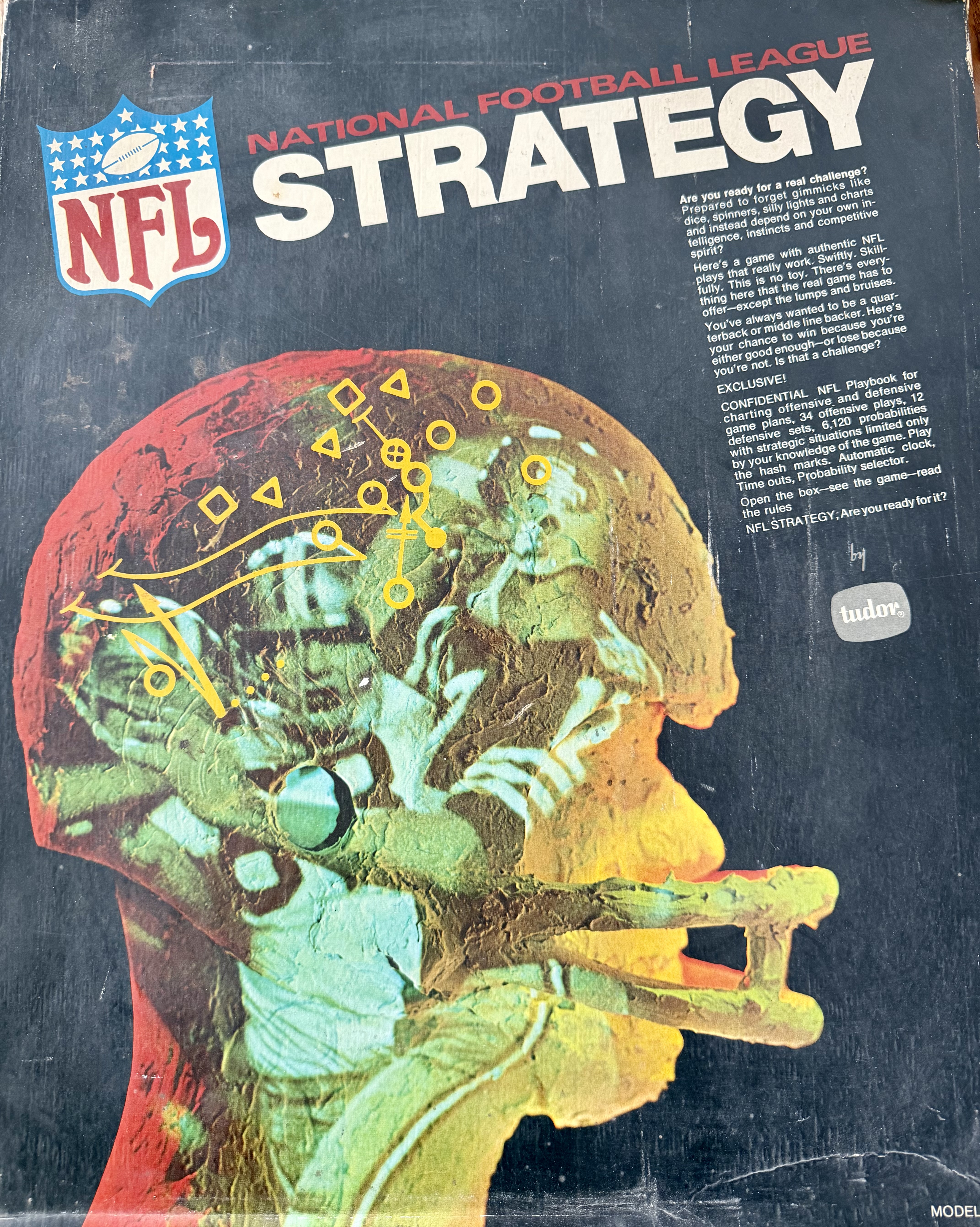
When I pulled the box off a shelf in the basement today, I noticed that the photo inside the helmet illustration that dominates the box cover shows John Brodie of the San Francisco 49ers passing as a Dallas Cowboy approaches him. Brodie, one of the Niners’ all-time greats, died last week. Finding him on the game box gave me another twinge of sadness.
I grew up a Browns fan but always thought the 49ers were cool. Whether it was their red and gold uniforms or their location in San Francisco, as a teenager I could imagine myself as a 49ers fan someday. Eventually it happened, as I worked in San Francisco and lived nearby during the years Steve Young led the team.
I never saw Brodie play in person, and I would have loved to have seen him in action at old Kezar Stadium. May he rest in peace.
As for NFL Strategy, it remains one of my favorite games, memories of which remain vivid to this day. 🧢

 The Ball Caps Blog
Very cool recollection. I never had this game, but now I want to know who shot the original photo that as made into the box cover image.
i’m glad you mentioned the photo. i just took a closer look. what a brilliant idea – photo inside the helmet with play diagram brains beside it.
Fantastic details Den. I really got into the football game you described, one I’ve never heard of before. I just finished watching the Rams – Seahawks. Bummer. I was rooting for the Rams, Great post on a great football day!