I am forever on the hunt for baseball books, and by chance I discovered through an electronic library “Terror in the City of Champions.” The book, published in 2016, chronicles the exploits of the Detroit Tigers and other Motor City sports teams in the 1930s against a backdrop of violent crime perpetrated by a ruthless gang of criminals called the Black Legion.
Although I was familiar with Tigers’ stars Mickey Cochrane, Hank Greenberg and Charlie Gehringer, I had not heard of the Black Legion, an offshoot of the Ku Klux Klan that formed in the 1920s and was flourishing in Michigan, Ohio and other Midwestern states during the Great Depression.
The book, by Tom Stanton, focuses on the rising fortunes of the Tigers as Mickey Cochrane, whom Connie Mack shed from the Philadelphia Athletics to save money, became Detroit’s player-manager in 1934.
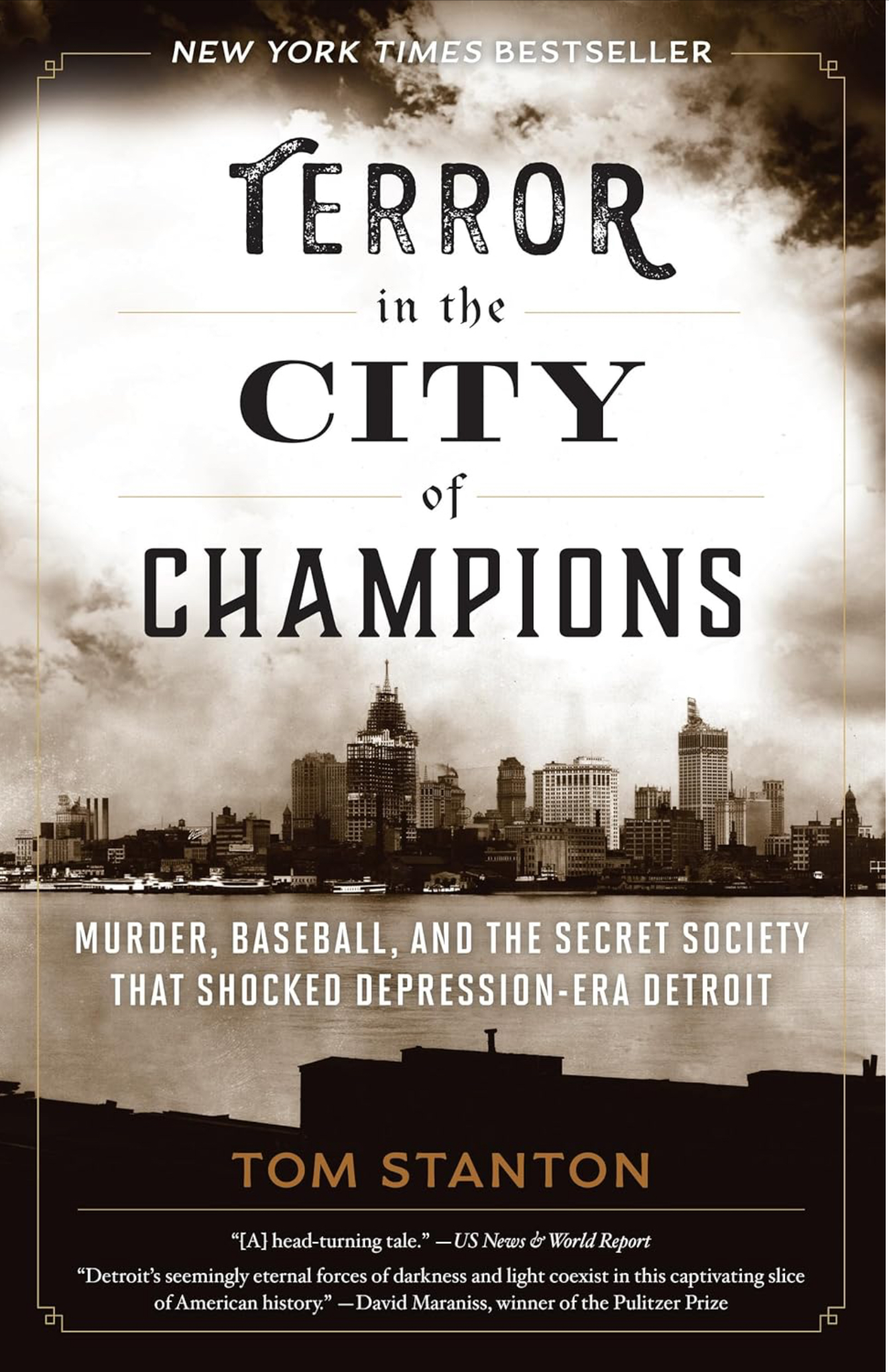
After the Ty Cobb era, the Tigers had fallen on hard times. Owner Frank Navin was desperately trying to revive the franchise and bring it its first World Series victory. Stanton details how the hard-charging Cochrane instilled confidence in his players, who slowly transformed into contenders for the American League pennant.
Led by strong, if erratic, pitching from Schoolboy Rowe, the Tigers won the pennant in ’34, only to fall to the Dean brothers and the St. Louis Cardinals in the World Series.
The Tigers’ ascension is set against the backdrop of the nefarious activities of the Black Legion, whose membership grew steadily in the Detroit area through coercive and brutal tactics. Men were lured to meetings described as patriotic gatherings, then forced at gunpoint to join the legion and pledge allegiance and obedience to whatever the group’s leaders demanded they do. Like the KKK, the group was populated by white supremacists who hated immigrants, blacks, Jews, Catholics and other minorities.
The legion had members in law enforcement who covered up crimes, passing off as suicide the executions of targeted victims, often innocent men dragooned into membership who tried to escape the group’s stifling grip. Families were threatened, homes were bombed, churches and businesses were set afire.
One of the most horrifying tales was of a black man shot to death just for being black, his killing arranged as entertainment for a group of legionnaires partying along a deserted road.
The book also delves into labor unrest in the auto industry, and one of the sinister figures was a Ford motor company hard guy who befriended Cochrane, who apparently did not join the legion but rubbed elbows with ruffians.
In 1935, the Tigers again won the AL title and defeated the Chicago Cubs 4 games to 2 in the World Series. It was a heady time for Detroit sports fans. Native son Joe Louis was pummeling his way up the heavyweight boxing ranks, the Lions won the NFL championship and the Red Wings won the Stanley Cup during the season that extended into 1936.
The Tigers tumbled into second place during in ’36, well behind the New York Yankees. Cochrane, stressed by front-office duties added to his player-manager role, suffered a nervous breakdown.
Around the same time, a Black Legion murder was finally pinned on the gang, resulting in convictions and starting a wider investigation of the secretive group’s crimes.
In 1937, Cochrane was seriously injured from a beaning and a few months later was sacked as manager. In 1947, he was inducted into the Baseball Hall of Fame.
Drawing from extensive research in newspaper clippings and other sources, Stanton brings that period of baseball and American history to life. As much as I enjoyed the baseball portions of the book, I was even more swept up in the history of the Black Legion. I highly recommend the book. 🧢

 The Ball Caps Blog
Woh….that is one excellent book review Dan. Thank you. I had no idea about the Black Legion. I wonder if they were active in Milwaukee? But just such an appropriate book for right now with what seems to be a rise in white supremacist groups or maybe they were always there, just dormant, waiting for a spark.
There was no mention of Milwaukee or Wisconsin, but I’ll bet the legion was active there, too. I have to admit, I did see a few parallels between what was going on back then and today’s America, alas.
I’m keeping a survivor pack ready just in case things get really worse.
I’d laugh, but there’s enough of a chance of mayhem these days that I’m suppressing the urge.